

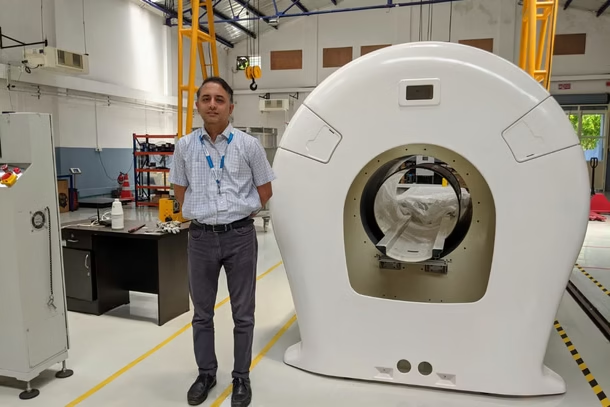
For years, India’s healthcare sector depended almost entirely on imported Magnetic Resonance Imaging (MRI) machines—elaborate, expensive, and energy‑intensive devices that remained largely out of reach for most hospitals outside major cities. This dependence not only drove up costs for patients but also limited access to advanced diagnostic care across semi‑urban and rural India.
Today, that story is changing. In a landmark achievement for Indian medical technology, VoxelGrids Innovations, a Bengaluru‑based deep tech startup, has successfully developed and deployed the country’s first indigenous 1.5‑tesla MRI scanner—a complex machine previously dominated by global giants like GE, Siemens, and Philips. The scanner is now operational at the Chandrapur Cancer Care Foundation in Maharashtra, marking a major step forward in healthcare self‑reliance.
From Vision to Reality: Make in India Meets Deep Tech
What makes this achievement especially significant isn’t just that the machine was built in India—it’s that it was built for Indian realities. Traditional MRI systems use liquid helium for cooling, which adds cost, complexity, and dependency on imported cryogens. VoxelGrids’ design eliminates the need for liquid helium with a more efficient helium‑free dry magnet system, drastically reducing manufacturing, maintenance, and operational costs. The result is a machine that is roughly 40% cheaper to produce, lighter, and more energy‑efficient than conventional MRI scanners.
This innovation aligns with the Make in India vision, which emphasizes high‑tech manufacturing and self‑sufficiency in advanced sectors like medical devices—areas traditionally dominated by foreign suppliers. The successful deployment of this MRI scanner shows how a focused combination of engineering excellence, patient capital, and strategic government support can overcome long‑standing import dependence.
Government Backing: Catalyzing Innovation
The Government of India played a pivotal role in enabling this breakthrough. The project received significant funding through government‑supported programmes, including grants from the Biotechnology Industry Research Assistance Council (BIRAC) under the Department of Biotechnology’s National Biopharma Mission. Of the early development costs, about Rs 12 crore came through these public funding channels, supporting research, prototyping, and testing phases essential for turning a laboratory concept into a clinically deployed system.
This backing reflects broader policy goals aimed at strengthening India’s medtech manufacturing ecosystem—a strategic priority under initiatives like Make in India, Aatmanirbhar Bharat, and targeted schemes to reduce dependence on imported medical devices. By investing in complex technologies such as MRI systems, the government is helping to build domestic capabilities that were once considered beyond reach.
Belief and Early Support: Zoho Founder’s Bet on Innovation
A defining moment in VoxelGrids’ journey came from the private sector when Zoho Corporation, led by co‑founder Sridhar Vembu, invested in the startup’s vision. In 2021, Zoho committed approximately $5 million (around ₹35 crore) in funding, marking one of VoxelGrids’ first major external investments. This deep‑tech capital was crucial in bridging a funding gap that often stymies hardware innovation—particularly for products that take years of R&D before commercialisation.
Vembu has spoken about the importance of developing indigenous industrial know‑how and nurturing technologies that require long‑term commitment rather than quick profits. His belief in founder Arjun Arunachalam and his team’s ability to tackle one of the most complex machines in medical diagnostics helped sustain the project through its toughest phases.
A New Era for Healthcare Access
The deployment of the indigenous MRI scanner in Chandrapur is more than a technical achievement—it is a statement about inclusive healthcare. By reducing the cost and complexity of high‑end imaging, VoxelGrids aims to make quality diagnostics accessible beyond tier‑I cities. Its design enables lighter installations and offers the potential for mobile MRI units, bringing advanced medical imaging to smaller hospitals and underserved regions that previously lacked such facilities.
This breakthrough underscores the power of India’s Make in India strategy when paired with bold entrepreneurship and strategic support from both government and visionary private investors. It is a reminder that even the most complex machines—once seen as out of reach for domestic innovators—can be built in India, for India.