

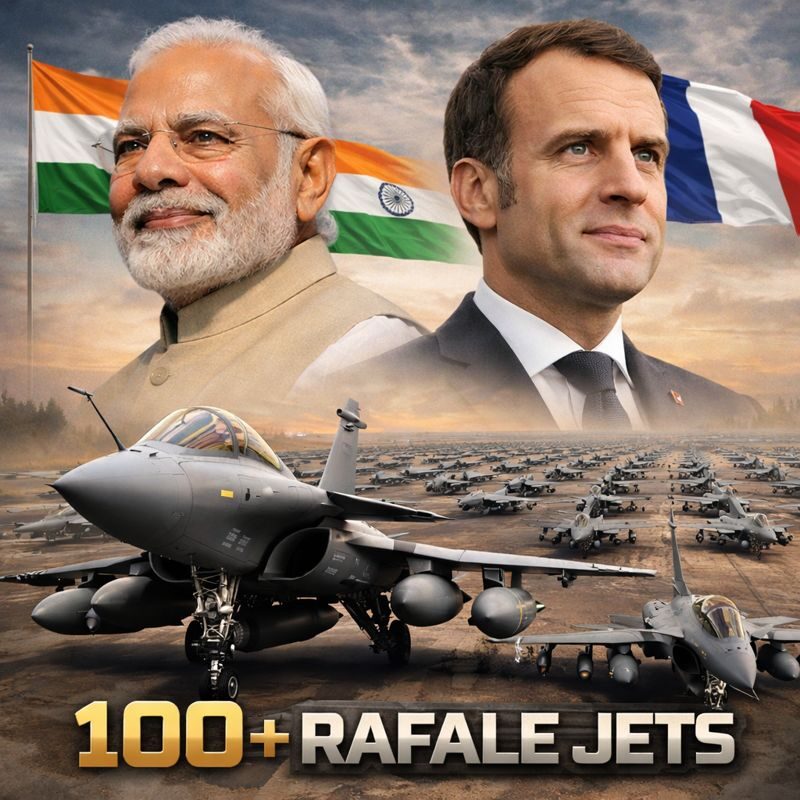
India is aggressively moving to bolster its aerial combat capabilities as part of a wide-ranging modernization of the Indian Air Force (IAF). Central to this strategy is a planned acquisition of over 100 Dassault Rafale multirole fighter jets, with the procurement process gaining momentum ahead of a prospective contract signing by 2026–27.
Addressing Squadron Shortfalls
For years, the IAF has faced a steady decline in squadron strength due to aging fleets and retirements of legacy platforms like the MiG-21 and MiG-27. At present, the IAF operates well below its mandated strength of 42 squadrons — a gap made more urgent by heightened regional tensions.
To address this gap, the service has moved forward with a government-to-government (G2G) proposal to procure up to 114 Rafale jets from France’s Dassault Aviation, a plan that could significantly enhance India’s combat airpower.
Why Rafale? Proven Performance & Strategic Fit
The Rafale, a twin-engine, delta-wing, multirole fighter, offers air superiority, ground-attack, reconnaissance, and nuclear delivery capabilities — all crucial for India’s strategic doctrine. The aircraft’s performance in international deployments and ongoing operations has reinforced its appeal to Indian defence planners.
Already, the IAF operates 36 Rafale jets successfully under a 2016 acquisition, and the platform has demonstrated robust performance, particularly in recent operational scenarios that underscored its deep-strike effectiveness and sophisticated sensor suite.
Procurement Strategy: G2G Direct Deal
Rather than relying solely on the long-pending Multi-Role Fighter Aircraft (MRFA) tender, India is considering an expedited government-to-government deal with France for direct procurement. This approach is intended to accelerate delivery timelines and leverage India’s existing Rafale infrastructure, training, and logistics frameworks.
The direct purchase strategy can also integrate ‘Made in India’ elements, where substantial domestic manufacturing — such as fuselage and avionics assembly — would be undertaken by Indian aerospace firms in collaboration with Dassault Aviation.
Economic and Industrial Implications
A deal of this magnitude — potentially exceeding ₹2 lakh crore (~$24 billion) — would represent one of India’s largest defence contracts. It also aligns with the government’s “Make in India” defence initiative, fostering technology transfer, skill development, and indigenous aerospace production capability.
Additionally, Dassault and Indian partners are reported to be laying groundwork to establish maintenance, repair and overhaul (MRO) facilities within India, ensuring long-term lifecycle support for a rapidly expanding Rafale fleet.
Regional Security and Strategic Edge
The Rafale acquisition comes at a time of escalating security concerns in India’s neighbourhood. Enhanced airpower not only strengthens deterrence but also ensures rapid response posture against multi-domain threats. A larger Rafale fleet can act as a force multiplier, enhancing interoperability with other air defence layers, including S-400 systems and indigenous platforms.
Outlook and Timelines
With formal proposals submitted and under review by India’s defence establishment, negotiations with France and Dassault are expected to intensify through 2025 and into 2026. Delivery of initial jets could begin thereafter, with further production and assembly scheduled across the latter part of the decade.
India’s roadmap to acquire 100+ Rafale fighter jets represents a major leap forward in modernising its air combat fleet. By combining advanced capabilities with domestic industrial growth, New Delhi aims to enhance both its defensive strength and strategic autonomy in an increasingly contested regional environment.
Source: Verified defence reporting — including ANI, Times of India, and industry procurement tracking aligned with AFI standards.