

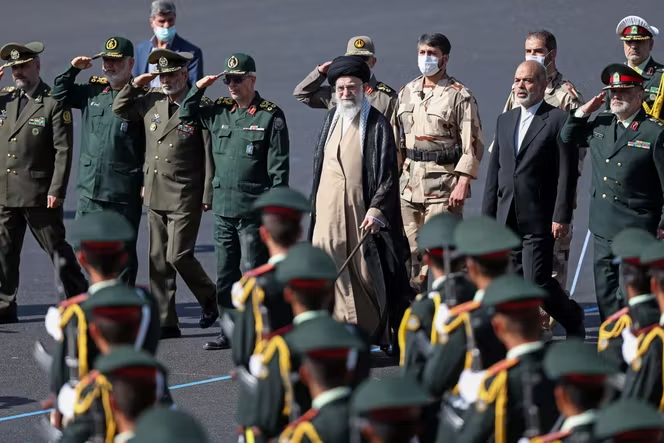
Iran continues to face intense internal unrest rooted in economic hardship, political repression, and widespread frustration with the Islamic Republic’s clerical leadership. Recent large-scale demonstrations — driven by spiraling inflation, unemployment, and restricted freedoms — have evolved beyond protests into broader demands for systemic change. Many inside Iran increasingly call for the end of the current regime and removal of Supreme Leader Ayatollah Ali Khamenei, whose authority has been challenged by years of crisis and conflict
The economic collapse of recent years, exacerbated by sanctions and government mismanagement, has intensified public anger more than earlier protests focused on specific issues like morality policing. This broader economic distress has mobilized diverse sectors of Iranian society — from students and laborers to small business owners — making this phase of dissent more widespread and potent.
Why Regime Change Is Complex
While internal pressures push toward radical change, regime change in Iran is far from certain. The Islamic Republic retains powerful security institutions (like the Revolutionary Guards) and ideological cohesion that resist collapse. Moreover, Tehran has shown a strong ability to suppress dissent through censorship (including internet blackouts) and force.
When assessing the idea of regime change — whether through uprising or external pressure — it’s crucial to understand that societal demands in Iran are not monolithic. Some call for reform, others for a complete overhaul of the political system, and many seek relief from economic suffering rather than foreign-led transformation.
The Role of the United States
The United States has historically been one of the most vocal critics of the Iranian regime, especially regarding Tehran’s nuclear ambitions and support for regional proxy groups. In recent years, U.S. policy has combined economic sanctions, diplomatic pressure, and rhetorical backing for human rights and democratic aspirations within Iran.
However, whether Washington actively supports direct “regime change” is controversial. Some analysts argue that while the U.S. expresses support for the Iranian people’s aspirations, overt intervention could backfire — strengthening hardliners and deepening anti-American sentiment.
Recent reports suggest that U.S. officials have discussed possible involvement in the context of heightened tensions and unrest, though the specific nature of that engagement remains unclear
Israel’s Strategic Considerations
For Israel, Iran represents a central strategic adversary. Tehran’s nuclear program, its support for Hezbollah, and its involvement in regional conflicts place it in direct opposition to Israeli security interests. This rivalry has periodically escalated into military skirmishes and covert operations.
Some Israeli perspectives view weakening the Iranian regime as reducing existential threats. However, regime change could also unsettle the region unpredictably, potentially empowering factions more hostile or chaotic than the current government. Thus, Israel’s approach is a balance between deterrence, containment and strategic caution.